Most couples who come to me have already tried. They have read the books, taken the courses, sat with a therapist, and walked out with a plan they both believed in. And it worked, for a few weeks, maybe a few months, before everything slid back to exactly where it was. In this episode I use an iceberg model I heard Brene Brown describe to explain why that keeps happening. The problem you can see is only the tip. Through the story of one couple who made the same plan five separate times, I walk down all four layers and show why the changes you make never last, and what actually has to shift for them to hold.
Listen to this episode here:
Watch this episode here:
Show Notes:
Follow Amanda on Facebook and Instagram.
Sources
Brené Brown, “Brené Brown on Protecting our Attention, Time, and Humanity in a World that Won’t Slow Down,” The Curiosity Shop with Brené Brown and Adam Grant, Vox Media Podcast Network, August 20, 2026.
The Donella Meadows Project, “Systems Thinking Resources,” on the iceberg model and its four levels.
Donella H. Meadows, Thinking in Systems: A Primer, Chelsea Green Publishing, 2008.
Emily Nagoski, Come As You Are, Simon & Schuster, 2015, on responsive desire and context.
Show Summary:
Miles and Corinne have been having the same conversation about sex for nine years.
It goes like this. He says she never initiates. He says when they do have sex, he feels like a chore on her to do list, one more thing to get through before she can go to sleep. She says she is exhausted and she does not know what he wants from her. He says he does not know either, he just knows this is not it. Somebody cries. Somebody apologizes. And then, because they are good people who want this to work, they make a plan. Twice a week. Tuesday and Saturday. On the calendar.
And it works. For about two weeks.
Then week three gets busy. A kid throws up, his parents visit, she gets a sinus infection, and they miss. Week four they miss again, and neither one of them says anything, because saying something means having the conversation again. By week six they are exactly where they started, except now they are carrying the extra weight of having failed at their own plan.
By their count, they have done this five separate times. Five different plans. Five identical collapses.
Miles and Corinne are not unusual. Most of the couples who come to me have already done a lot of work. They have been to therapy, sometimes with two or three different therapists. They have read the books. They listen to podcasts, this one included. They have taken courses, done the worksheets, and walked out with a plan they both felt good about. And it works. For a while. Then a few months go by and they are back in the same dynamic, wondering what is wrong with them that they cannot make anything hold.
So the question they bring me is almost never what should we do. They have a long list of things to do. The question is how do we make it stick. How do we stop sliding back into the same old patterns.
That is what I want to answer today. It is also why the coaching I do is the answer for so many couples who have already tried everything else.
The part you can see
I recently heard Brené Brown talk about why this happens on her podcast with Adam Grant, and she used a model I had not seen. But when I heard it, I knew instantly that it could be applied to marriage and coaching.
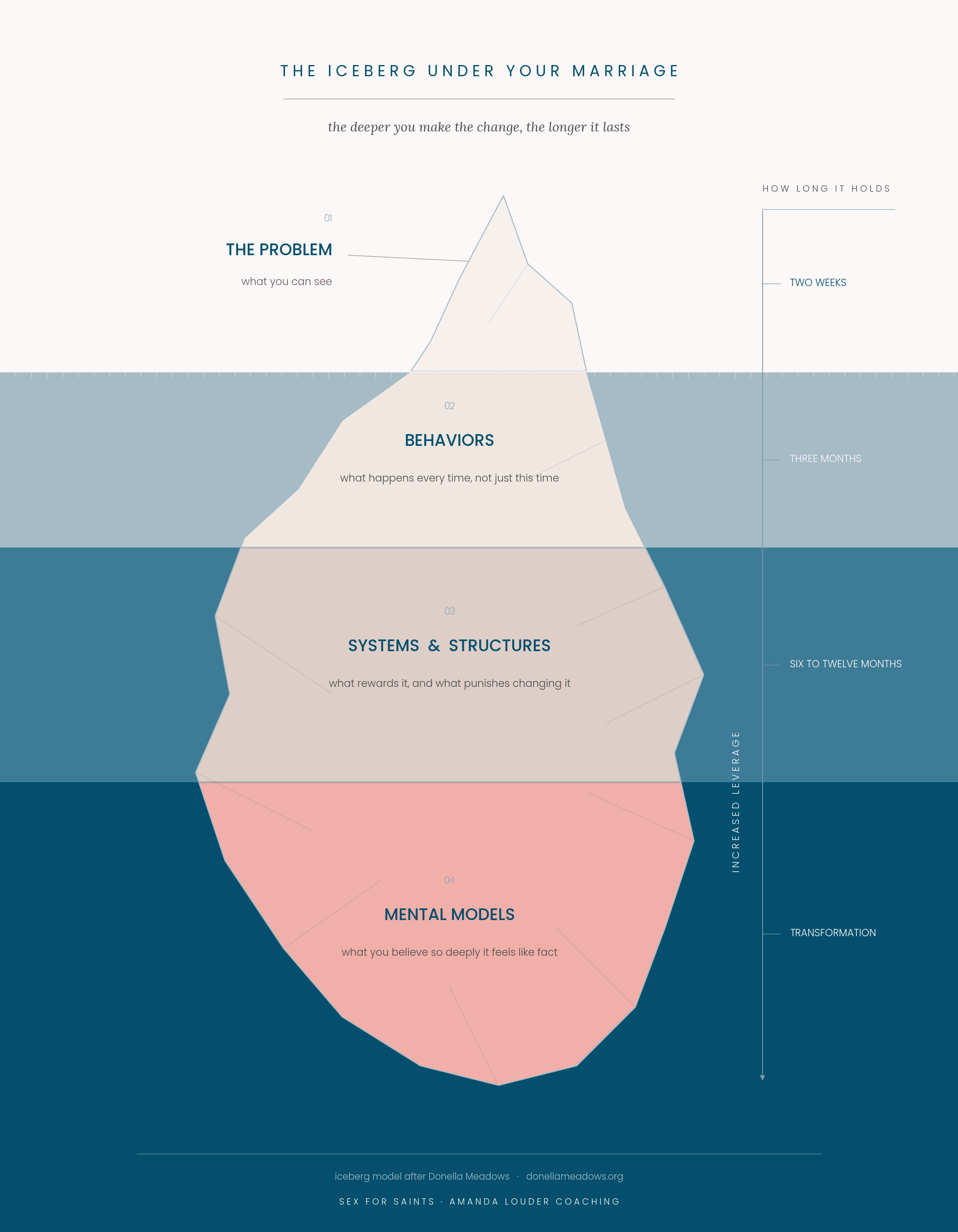
Picture an iceberg out in open water. What you can see of it is the tip, the part sitting above the waterline. In marriage, the tip that you see is what couples often think the problem is. It’s the easiest to identify and focus on.
But roughly ninety percent of an iceberg is under the water. The part you are looking at is not most of it. It is not even close to most of it. It is the small visible end of something enormous, and the shape of the whole thing is what determines where that tip sits and how it moves.
Underneath the waterline, that mass is not one solid block. It goes down in layers, and each layer is a different kind of thing. Just under the surface are behaviors. Below that are systems and structures. And at the very bottom, holding all of it up, are mental models.
I am going to take each layer, in order, and explain what it is and how it shows up in your marriage and what the consequences of each of those are.
Layer one, the problem
Let’s start at the top, above the water. For Miles and Corinne, the problem is stated as frequency. They are having sex less than he wants and more than she wants, and it has been that way for years.
Frequency is the event. It is the visible thing. It is countable, so it feels like the real issue, and it is the easiest thing in the world to build a solution around. Put it on the calendar. Set a goal. Twice a week.
I want to be careful here. Scheduling sex is a genuinely useful tool for some couples, and I recommend it often. The problem is not the schedule. The problem is that Tuesday arrives and Miles is still the man who does not know how to ask for what he wants, and Corinne is still the woman who believes sex is something she does for him. The calendar does not touch either of those. All it does is tell two unchanged people what day to be unchanged on.
Frequency is just Miles and Corinne’s version of it. Yours might be the same or it might be different.
Maybe the problem is porn. Maybe you have not had sex since the baby was born, and the baby is four. Maybe sex happens regularly and one of you has never once finished. Maybe touch has only ever led to sex, so now one of you braces at being touched at all. Maybe it is the same argument every Sunday afternoon. Maybe you are both on your phones in the same bed until one of you falls asleep. Maybe one of you says yes and the other one can tell it is not really a yes.
Every one of those has an obvious solution sitting right next to it, and the solution is always a thing you do. Install a filter. Put date night on the calendar. Buy the book. Try the new position. Make a rule about phones after nine. Make a rule about not bringing hard things up at bedtime.
Two weeks is about right for that. Two weeks is how long willpower lasts when it is the only thing holding the change up.
Look at what the calendar actually asked of them. Tuesday night comes and Corinne has been up since five thirty, she has a work thing Thursday she has not started, and the last thing she wants is sex. She does it anyway, because it is Tuesday and they agreed. But Miles can tell. He does it anyway, because stopping means they failed the plan two weeks in, and then he has no idea when it happens again. He also figures that if he stops, she will be the one who feels rejected. Neither of them says any of this out loud. So Saturday they do it again, and by the third week when a kid is throwing up at midnight, missing it is a relief for both of them.
Then it collapses, and this is the part that does the real damage. They do not blame the plan. Corinne decides she is broken. Miles decides she does not want him and probably never has. Five collapses is not five failures of effort. It is five signals that whatever is driving this is somewhere they have not looked yet.
Layer two, behaviors
Go down one layer and stop looking at what happened Tuesday. Look at what happens every time.
Here is Miles’s pattern. He does not ask. He tests. He comes up behind her while she is loading the dishwasher and puts his hands on her waist, and what he is really doing is running a diagnostic. If she leans back, the answer is yes. If she stiffens, the answer is no, and he takes his hands off and goes quiet for the rest of the night. He has never once said the word sex out loud in that kitchen.
Here is Corinne’s pattern. She waits to be in the mood before she will say yes to anything. She is rarely in the mood at 9:15 at night after fourteen hours of being touched by children. And when he touches her while she is mid task, her whole body tightens before her brain has caught up, and then she feels guilty about the tightening, and the guilt makes the next time worse.
Emily Nagoski’s work is useful here. Plenty of people, women and men both, do not experience desire out of nowhere. Desire shows up in response to something good happening first, which means waiting to want it before you will go near it is a strategy that will keep you waiting.
So you can change behaviors. Miles can say out loud, in the afternoon, that he wants to have sex tonight. Corinne can stop answering with a flat no and start answering with a real answer, like not tonight, and I want to on Thursday. Those are good changes. I teach them constantly.
And they will hold for a few months. Then a hard week comes, and he is back to testing her and she is back to a flat no, because the new behavior was running on effort, and effort runs out.
Three months is about the ceiling, and I think a lot of that is nervous system. The old behavior is familiar, and familiar registers as safe, even when you hate what it produces. Miles testing her instead of asking kept him from ever hearing the word no. Corinne’s flat no ended the conversation before she had to say anything about what she actually wanted. Both of those feel terrible, and both of them are doing a job. The new behavior does not offer that. Every time he asks out loud he is exposed, and every time she gives a real answer she is exposed. So the first hard week, a sick kid, a deadline, a fight about money, their bodies go back to what is familiar, and familiar wins.
Layer three, systems and structures
Now go down another layer and ask a different question. Not what do we do. What have we built that makes this the natural outcome? What rewards this? What punishes anyone who tries to change it?
Miles and Corinne have a household structure. She does the kids, all day, and the cooking, and most of the house. He does the kitchen clean up and the lawn and the cars. That structure means she is touched more or less continuously from the time the kids get up until they are finally down at nine, and he is not touched by anyone all day. By the time they are in the same room, one of them is starving for contact and the other one is saturated with it. They are outputs of a structure.
They also have a structure around who is allowed to bring it up. Miles brings it up. Corinne responds. That has been true since their honeymoon, and it means every conversation about sex in their marriage has started from his wanting. She has never had to develop a way to say what she wants, because there has never been a slot for it.
They have a structure around when they talk. They talk about sex at night, in bed, immediately after a miss, when one of them is already hurt. That is the worst possible time, and it is the only time it happens.
And they have a structure they did not build, which is the one they inherited. Both of them grew up in a church culture that gave them a great deal of specific instruction about not having sex and almost nothing about having it. They had lessons, interviews, and standards nights on one side of the wedding, and on the other side of the wedding, silence. That is a structure. It shapes what they know how to say out loud, and what they assume everyone else already figured out.
Look at what these structures reward. When Corinne declines, she gets sleep, and she gets out of it tonight. The hard conversation still comes, in bed, after the next miss, and that is later. Later is not right now. When Miles goes quiet, he is rewarded with not having to hear no a second time. Both of them are getting something every single time they do the thing that keeps them stuck.
And look at what these structures punish. If Corinne says out loud that she wants something specific, she risks being the wife who is too much, which is a thing she has been afraid of being since she was fourteen. If Miles says he wants to be wanted, not just accommodated, he risks sounding needy, and he was raised to believe men do not get to ask for that.
Change these structures and you will get real traction. Move the conversation to a Saturday walk. Have Miles take the kids for a stretch of the evening so Corinne gets forty minutes where nobody is touching her. Give Corinne a standing place to say what she wants. Six months. Nine. Maybe a year. It holds that much longer because a structure does not run on willpower. Once Miles has the kids from six to seven, Corinne is not deciding every night to protect her own evening. The arrangement decides. She gets the forty minutes whether or not she had the energy to ask for them that day.
What undoes it is that structures get renegotiated. A new baby, a new calling, a job change, a kid starts a sport that eats three evenings, and the schedule opens back up. When it does, the same two people rebuild it, and they rebuild it to fit what they believe. Corinne can come to bed rested and still believe sex is something she does for her husband. Miles can have a standing Saturday walk and still believe he does not get to ask to be wanted. Better conditions, same meaning, and inside of a year they are back to the status quo.
Layer four, mental models
And then there is the bottom of the iceberg, which is where almost nobody goes, because it is slow and it is uncomfortable and there is nothing to check off at the end of it.
Mental models are the beliefs underneath everything. They are so old and so deep that you do not experience them as opinions. You experience them as the way things are. Facts.
When Corinne and I got to this layer, what came out was this. She believes, at a level she had never realized before, that sex is something a wife does for her husband. Not something she participates in. Not something she wants. Something she does for him. She could not remember ever being taught that explicitly. It arrived in a hundred small pieces, over many years, and by the time she was married it was simply how the world worked.
Notice what that belief does to every layer above it. It makes his asking a request for a favor. It makes her yes a service and her no a refusal to perform one. It makes her own wanting completely irrelevant, which is why she never developed a way to talk about it. And it means that a schedule built on top of it produces a wife doing sex for her husband on Tuesday and Saturday.
Miles had one too. His was that a man does not get to ask to be wanted. He can ask for sex, and he can be turned down for sex, and both of those are normal. But wanting his wife to want him felt to him like a weakness he was not entitled to have. So he tested instead of asking.
There was a second one underneath that, and it is one I hear from Latter-day Saint men constantly. He believed that his desire for sex was the natural man. He had spent his adolescence being told that his sexuality was the enemy, and then he got married, and nobody ever told him it had stopped being the enemy. So every time he wanted his wife, some part of him flinched at himself.
Those are the load-bearing beliefs. Every behavior and every structure above them was built to be consistent with them. That is why the plans kept collapsing. They were remodeling the top of a house whose foundation was pouring the shape of everything.
Now look back up the iceberg and count what you get at each level.
Address the problem and nothing else, and you might get two weeks. Address the behaviors underneath it and you might get three months. Get into the systems and structures and you might get six months, nine months, a year if you are lucky. Go all the way to the bottom and touch the mental models, and THAT is transformation. Brené called it “excavating and breaking.”
The model itself comes out of systems thinking, and the Donella Meadows Project has been teaching it for years. Meadows was a systems theorist, and one of her core ideas was leverage points, the places in a system where a small change produces an outsized shift. The deeper you go in the iceberg, the more leverage you have, and the less the change depends on you holding it up. What is down there is harder to reach and harder to look at, and it is also the only work that does not have to be redone every few months.
How you get down there
Getting down there is the hard part, and you do not do it by deciding to. You get there by asking questions that go backward instead of forward.
What did I learn about sex before I was twelve? Not what I was taught in a lesson. What did I absorb from how the adults around me acted when the subject came up.
What would have to be true about me for me to want sex? And what would it mean about me if I did?
And then the question that does the work. Do I still believe this?
Because most of what is down there was installed when you were young, by people who were doing their best with what they had, and you have never once taken it out and looked at it as an adult with your own agency. Some of it you will look at and keep. Some of it you will look at and realize you have been running your marriage on a belief you do not actually hold anymore and have not held in years.
Those are examples of the kind of questions you should be asking yourself. And when you do that, on your own, you will probably get answers that sound reasonable. But, you will stop about one layer above the thing you are actually looking for, because you cannot see your own water. The belief running your marriage is the one that feels least like a belief, which makes it the one you will defend the fastest and walk right past without noticing.
There is a second problem. Plenty of people already know exactly which belief is running them. They can name it. They have been able to name it for years and it has not changed anything, because knowing what a belief is does not tell you how to change it. This is usually where people reach for affirmations, and affirmations do not work here. You cannot talk yourself into believing something your body has years of evidence against. There is an actual process for changing a belief you have been carrying since you were fourteen, and teaching that process is most of what I do with clients.
That is the excavation. It is slow, it does not feel productive, and it is the only place where change stops requiring maintenance.
When only one of you is willing
The question I get most often, right about at this point, is what any of this looks like when your spouse has no interest in doing it with you. Della and Jonah are the answer I usually give.
Della started doing this work by herself. Jonah was not opposed, he just did not think he was part of the problem. It was a her issue, not his. She decided to go ahead anyway. She spent the better part of a year on her own beliefs about her body, her wanting, and what she thought she was for.
Her mental model changed first. Then her behavior changed, because she stopped waiting to feel something before she would go looking for it. Then the structure changed, because a woman who believes her wanting counts starts asking for things, and the household rearranges itself around a person who asks. Jonah did not have a conversion moment. He noticed his wife was different, and he got curious, and about fourteen months in he started doing his own excavating.
I believe a marriage can change with one person doing the work. It works better with two. If your spouse is not willing right now, that is not a reason to wait. It is a reason to start.
Miles and Corinne
Which brings me back to Miles and Corinne. They did not make another schedule.
Corinne spent about four months underneath the waterline, and the thing that shifted was not her frequency. It was that she stopped treating her own desire as a detail that did not matter. Miles spent that same time working on the belief that wanting his wife made him a problem, and separately on the belief that asking to be wanted made him weak.
The behaviors changed after that, and the strange part, the part they both commented on, is that the new behaviors did not take any effort to keep. He stopped testing her in the kitchen because he no longer needed to protect himself from an answer. She stopped bracing when he touched her because touch stopped meaning a bill was coming due.
They are not perfect at it. They have bad weeks. The difference is that a bad week is now a bad week, and it does not undo anything, because there is nothing propped up that can fall over.
Now that you have the layers, I can tell you plainly what coaching with me actually is. It is not a plan. It is not a set of behaviors to try, and it is not a rearranged schedule, though both of those can end up being part of it. What we are doing is finding the beliefs at the bottom, the ones you have never taken out and looked at, and deciding together whether you still hold them. That is the layer everything else is sitting on. Change it and the behaviors and the structures move on their own, and you stop having to hold anything up.
That is why it sticks when the courses and the plans did not. They were working above the waterline.
If you have been solving the same problem in your marriage over and over, and it keeps coming back with a slightly different face, you are probably working up there too. And the invitation is to go down one layer. Just one. Ask what pattern is underneath the incident, and then what structure is underneath the pattern, and then what you believe that makes all of it make sense.
That is where the leverage is.